Showing posts with label energy. Show all posts

Saturday, 1 May 2021

A Letter to the Children of Class P4

Candidates were invited to respond to the letters written by the class of P4 of Calderbridge Primary School, Wishaw. The children have already received my letter. Below is a copy of my reply to their questions and concerns.

Dear Sophie, Dylan, Eva, Taylor, Polly, Caleb, Alexa and all of the class of P4.
Thank you very much for your letters and for telling me of your worries for the environment and the future of the planet. I am typing my reply because my handwriting is not as neat as yours!
May your teacher, Mrs Currie-Smith, forgive me for the long reply. I feel I am able to do so because I have some things to say. Like I hope many of you will be able to, I was lucky enough to go to university. For me, it was not once but twice. The first time I studied geology, that is the history of the Earth. The second time I studied energy, that is how we use energy to power our lights, homes and phones, and the problems that come if we continue to use the wrong kind of fuels.
You may have heard the term “fossil fuels”? I’ll try to keep this short but it is important to know why burning them as we do today is a bad thing for us and for the animals and plants we share our planet with. So I will tell you, briefly, where fossil fuels come from.
Many hundreds of millions of years ago, there was no life on land. There was life in the sea but on land, there was nothing but deserts. Plants started to colonise the land, spreading out from rivers. Plants use sunlight as an energy source to grow and elements from the ground and air for material. As plants evolved, over millions of years, trees formed vast forests which grew over the land. They took the carbon they needed to form their wood from the air and the hydrogen they need for food from water. When these forests died, their remains were buried and, again over millions of years, the dead wood formed vast coal beds. This is important to remember.
Other plants stayed in the oceans. Many millions of years after the coal beds formed, there were so many tiny plants in the oceans (this was during the time of the dinosaurs) that, when they died they sank to the bottom of the seas. Usually when this happens the plants are eaten but there were special occasions when they were buried instead. So much material that was buried that oil and later, gas, started to form in the rocks from their remains. Like coal, they are made from carbon and hydrogen and there are huge amounts of them. Together coal, oil and gas are known as fossil fuels.
A lot lot later. Tens of millions of years later, people came along. Our ancestors. For thousands of years we have grown crops using just sunlight and water. Power for our tools came from ourselves, animals like oxen and horses, the wind and water for grinding our wheat and for sailing our ships. About 300 years or so ago, we discovered that coal could be burnt to boil water, and the steam used to give greater power to our machines. Our ancestors first used these as pumps to keep mines clear of water, power looms to make cloth and then turned the pumps into steam trains to move goods and people across land, and later steam ships to carry cargo from continent to continent. Later still, we used oil to power our cars, trains, ships, airplanes and tractors, and gas to heat our homes and schools. Coal, oil and gas are still used to generate electricity. We were able to grow more crops, develop more chemicals and medicines, and so, during the 20th Century, the century I was born, there grew to be so many more people than there was previously on Earth. When I was born, there was about three and a half billion people alive. Now, in 2021, there are nearly eight billion people alive! Each one of us, you and me included, need to be fed, kept warm (or cool) and to have a decent life. We need fuel to do this.
Here’s the problem. Currently we still rely upon fossil fuels, coal, oil and gas, to power our machines. To give it a percentage, 80% of the energy we use for our electricity, heating, cars, ships and airplanes comes from these fossil fuels. As we burn these fuels, the hydrogen and carbon that was locked up in the Earth for tens and hundreds of millions of years is being released back into the atmosphere. The hydrogen is not a problem: the combines with oxygen to form water. Oxygen combines with carbon too, forming carbon dioxide (known as CO2). When this happens in large amounts, there is a problem because CO2 helps locks the heat of the sun into the Earth’s atmosphere. And we are doing this over a very short amount of time: a couple of hundred years. Compare that with the millions of years it took all that carbon to be locked up into the ground! Over the past couple of hundred years, we have released thousands of billions of tons of CO2 back into the air. So much so, that the percentage of CO2 in the atmosphere has not been so high since long before people first evolved on Earth. The rate of change has been very short: a couple of hundreds of years. Animals have not had a chance to evolve quickly enough over such a short period of time. The additional heat, trapped by the CO2 blanket, is warming the planet and is the reason the ice caps at the poles are melting. This is the reason why animals like polar bears are having problems. Taylor, you mention the that it is the Sun that causes the ice caps to melt and the fires to burn. We cannot do anything about the Sun but what we can do it control the amount of CO2 in the Earth’s atmosphere.
The extra heat trapped by the CO2 does not just sit and mind its own business. Heat is a form of energy. That energy is used in some places to form strong storms and floods. In other places, droughts occur, causing forests to burn more quickly and over greater areas than before. You mentioned the fires in your letters Dylan. There have always been droughts, storms and forest fires but seldom have there been so many happening time and time again. This is all part of climate change, caused by people like us, over the past few hundred years.
Sophie, you asked what will happen when all the ice caps will melt? It will be a big problem if this happens. Many cities will have to be abandoned and more people will have to find new places to live. We have to do what we can to keep the rise in global temperatures down and preserve the ice caps.
As you ask Polly, what can we do about it? As I said, we are still burning too many fossil fuels and allowing too much CO2 into the atmosphere. If we suddenly stopped though, a lot of people would have a hard time and even die! Homes could not be heated or cooled, which means that in hot summers or cold winters, people would suffer from either heat or cold stress in their own homes. More people would starve because we use fossil fuels on our farms while growing food. I do not mean to scare you but that is the truth. Like you Alexa, I want a good future! It is facts like this why politics and who is elected to be politicians is important. We have to make the choices for the way forward. The choice cannot be between animals and people, the environment or our homes. All are important but the way forward is not easy. In order to achieve the good future that you ask for Eva, politicians have to listen to scientists. This is where we can get objective information from. It is important for you and me to be informed as to what the facts are. Unfortunately a lot of people do not listen to facts, preferring to hold their own opinions. Many people chose to believe only those facts that back the ideas and opinions they already hold. A very big example of this is the current president of Brazil, who is ignoring the science and encouraging big landowners to continue cutting down the rain forests of the Amazon. The world has to tell President Bolsonaro that he is wrong and that the rain forests of Brazil need to be saved.
Another part of the answer to the problem is for us to need less energy. We all need to insulate our homes against the cold in Scotland so we need less fuel to heat them. We also need to get away from releasing carbon when we produce our energy. Solar panels and wind turbines are some of the ways to do this but they take up a lot of land (or sea). Plus we need to store the energy produced. That is a whole load of other technology but here is a hint - batteries are not the best way to store large amounts of energy. Politicians can help to bring all these things about.
The oil and gas industries want to find ways of separating the carbon from the hydrogen before we burn it. The hydrogen would be burnt and the carbon pumped back into the ground. If they succeed, this would get us through your lifetimes but would not be an answer for your grandchildren.
You mention cars Caleb. It is true that we all need to use them less often and that their fuels need to change. I admit I love driving but whenever it is practical, I take the bus and leave the car at home. Cycling is also very good for us but we need better cycle lanes. In this we are still very far behind our neighbours in Sweden, The Netherlands and Germany.
These things are all complicated. I would advise you to be careful of any politician who claims to have easy and quick answers. In truth, not many people, including politicians, understand all the problems involved and how to solve them. That is why we have to work together and be guided by science and the facts. It is up to politicians like me to decide what can be done, what must be done and how fast it is possible to do it. In a democracy like ours, politicians cannot give orders. We have instead to pass laws that can make the system work how we all need it to be.
What can you do at your age? My best advice to you is to give space to the small things near to you. Polar bears and penguins are important but far away. Look after the nature that is close to your homes and gardens. Plants and insects are important. Give homes to bugs like slaters, insects like bees and plant native species if you have gardens. If you don’t (and even if you do) have a garden, ask to join in local conservation groups and get to know and help your local environment and wildlife.
Why is this important? Polar bears don’t eat ice. They are what biologists call apex predators. They need seals, who in turn need fish and squid and, in turn need smaller fish and crustaceans (like shrimp) who ultimately need plants. So the key is to look after the small stuff like plants and bugs and the environment in which they can be happy. If there is enough of them, they will feed larger animals and ultimately big animals like polar bears.
I am sure you have many questions. I am sorry I am not there to answer them. Perhaps one day I can visit your class and answer your questions in person. For the moment though, that is not possible. I am also sorry my letter to you is so long. It is a problem that really interests me. I wish to have the opportunity to deliver answers directly to you, the people of Motherwell and Wishaw and to our country. Maybe one day I will be in the position to help people and the environment better than I am now but for now that is up to your parents and how they vote.
I am proud to be a Liberal Democrat because although we have policies designed to address all the challenges I have told you about, the party does not say to me “You have to think this way and say these things.” Being a liberal means thinking for yourself. I have benefited from wonderful teachers who have helped me to do so. I am old: 55 this year. The last time I sat an exam was only three years ago so, whatever we do, we can choose never to stop learning. Make the best of your time at school. If you need help, ask for it. For those you who do well, everyone can celebrate in your success. If your classmate isn’t doing so good, ask them how you can help. Look after and be kind to each other. If you look after each other, then there is a good chance that your generation will go on to look after the planet too.
If you have any more questions, please give them to Mrs Currie-Smith to pass on to me. I cannot promise to get back to you ahead of the election date but I will try my best.
Kindest regards and best wishes,

Friday, 17 February 2017

Global Population and Energy

I had not heard of Hans Rosling before I saw his 2013 programme Don’t Worry: The Truth about Population which the BBC re-aired after Rosling’s death this month at the age of 68.  It was really impressive: a great communicator and a first-class mind has left us.  My condolences to Rosling’s family and colleagues.

What Rosling has to say though about population growth is vital for all of us to understand if we care about humanity’s future.  The planet will be fine: over geological time it has seen many mass extinctions.  After a few million years there is always a flurry of evolution as descendants of surviving species exploit the available ecological niches and, in their turn, evolve into new species.  If this happens, then the chances are that humanity will not be around to see it.  No, it is what Rosling said about the population growth by 2100 that must concern us.

Before watching his lecture, I was led to believe that global human population would be capped by available resources at nine billion.  Apparently it is not so, as Rosling is predicting a population of eleven billion by 2100 and probably continuing to rise, albeit more slowly, thereafter. Currently the world is at seven billion - an increase of three billion during my own lifetime. Population levels have already stabilised in the northern nations: Europe, North America and Russia.  Latin America and Africa will see a doubling of their populations but Asia will see the bulk of new people.  This growth is not led by large families either.  Rosling points out that even in 2013, the average family in Bangladesh only has 2.5 children.  No, it is through most of us living longer that the the numbers of humanity will continue to growth.  Failing some drastic cataclysm, the momentum is now unstoppable.

Today we are in a world where the first stresses of this population rise are being felt.  The northern nations are the first to be living longer and having fewer children so our populations are stable, if not falling slightly as the old start to outnumber the young.  On the whole, people are defensive when it comes to foreigners and it is that that is leading to the rise of nationalism in all parts of the north: Putin, Trump, May and Le Pen.  This will only be a phase though as the momentum of humanity will ultimately be too great for such barriers to withstand.  The more serious struggle will be that of resources.

In my own field, that of energy, part of the social-conservative backlash has been directed against the new technologies of renewable energy.  I recently put up a comment on Twitter pointing out that while there is nothing wrong with the government investing in a new centre to maximise the exploration of North Sea oil and gas, they have severely cut investment in renewable energy at the same time.  Responses I got back were “Good: anything that requires a subsidy is a waste of time” and, more succinctly, “Green crap.”  Both responses come from the same source: social conservatism.  Or as a Tea Party member once told me: “All we want is simple.  Leave us the hell alone.”  That is not going to happen but it is nothing to do with political ideas.  It would be through weight of numbers.

There is also resistance from developing nations too.  Many see that the North has built wealth on the back of fossil fuels but now a section of us are saying that renewable energy is the only viable future.  The suspicion is that this is just a cover for the North to keep the fossil energy for themselves and slow down the economic development of people in the South.  “Why cannot we use oil and coal to generate wealth has you have done?” they ask.

Although the demise of fossils fuels have been predicted for some time, they will eventually run out.  If Rosling is correct and the population will rise even further than the often-cited nine billion, this will inevitably happen sooner rather than later.  That is an obvious problem for us all.  For instance, there is not one scenario being offered to the UK government that does not involve fossil fuels.  That is including from Friends of the Earth.  Even they cannot see a society model that, by 2050, we have cut our dependency on fossil fuels by more than fifty percent from current levels of consumption.  What happens to human civilisation when we are literally burning up our last scraps of coal?  I do not know but considering out current state, there cannot be a good outcome.

How much do we have left?  According to my current lectures at Heriot Watt University, the planet has about 40 years of oil, 50 years of gas and 90 years of coal left to use.  This is based upon rising demands for energy up to 2035.

Perhaps at this point I should address the basic issue about finite fuels.  After all, we always seem to be able to find more of the stuff.
 
Coal, oil and gas comes from the buried fertility of life on the planet.  Soon after the first plants were able to leave the seas and colonise land, there was an explosion of life. (Remember what I said about ecological niches being occupied?).  The first forests formed about 360 million years ago, during the geological period known as the Carboniferous.  Although there are coal reserves from younger periods (such as the lignites of Poland), it is mostly the remains of these ancient first forests we are burning.  Dry gas is associated with these coal beds.  That is the source of the gas fields of the Netherlands and the Southern North Sea.

In contrast, oil comes the biological productivity of ancient oceans.  The Northern North Sea oil comes from the Kimmeridge Clay, a carbon (fossil) rich layer of mud laid down only over a few million years about 155 million years ago.  Different areas of the world will have different sources but roughly similar mechanics.  The source rocks for the Gulf area (Saudi Arabia, UEA, Kuwait, Iraq and Iran) were laid down over a protracted length of time (about 80 million years!) during the formation and destruction of the an ancient ocean called the Tethys.  That is why about half the world’s oil reserves are to be found in this region.  As these muds, rich in the remains of marine plants and microscopic animals, are buried and heated, the chemical reactions start, over millions of years, to produce crude oil.  If that oil is heated further, wet gas is produced.  Heat it too much though and all the hydrogen is driven off, leaving only inert carbon.

Traditional drilling and oil exploration focuses upon finding the accumulations of this oil and gas as the fluids migrated and are trapped in rocks.  Fracking is only different insofar that the hydrocarbons still trapped in the original source rocks are freed up by mechanically breaking up the mudstones.   The point is about fracking is that after the source rocks have been exploited, there is nowhere else to go.  Fracking is a symptom that the sponge is starting to be squeezed in order to extract the final drops.

What of nuclear though?  Current power stations are based upon the fission of uranium.  This technology is problematic because of the weaponisation of byproducts.  Nuclear weapon technology is jealously guarded, even if that particular genie is out of the bottle.  However, this particular blog is about energy and not nuclear weapons.  Although there is plenty of uranium left in the planet, most of it is beyond the reach of human extraction. Only small quantities are trapped in the Earth’s crust and therefore mineable.  Current reserves are thought to be good for another seventy years.  Thorium is a far more plentiful element but there has been little investment in extracting the power contained within it.  Probably because its byproducts has far more difficult to weaponise.

In short, the world is not expected to have a single finite source of fossil energy expected to last beyond this century.

I haven’t even started to talk about what burning all these ancient reserves are doing to the climate.  The big question is:
Is mad-made climate change, caused by the burning of fossil fuels, real?

Quick answer is yes.  Yes, it is real.

Climate-change deniers use the figure that “only” ninety seven percent of scientists claim that climate change is man-made and that they speak for the brave three percent.  Even this is a lie.


Have a look at this graph from jamespowell.org.  Climate change deniers have had zero impact on the scientific debate on the evidence.  This means that there is either a global conspiracy involving millions of scientists or, more likely, the evidence for man-made global warming is effectively unanimously accepted by those who consider the evidence.
 

Climate change deniers also point to natural climate change variation during geological time.  This indeed happens.  The next graph, from the University of Berne, shows the natural carbon dioxide level (CO2) over the past 60,000 years in terms of parts per million (ppm).  The ramp up from 20,000 to 12,000 years ago covers the period of glacier melting at the end of the last Ice Age.  The spike, right at the end, covers the last two hundred years up to 2004 - the period of the industrial revolution.  In 2016 CO2 have now past the 400 ppm.  As explained previously, the majority of fossil fuel energy which as been locked up in the planet’s crust is now being liberated into the atmosphere.  


CO2 is a vital atmospheric component for preserving solar radiation and keeping the planet warm and habitable.  Never in the course of geological history however has there been such a rapid and concentrated injection of CO2 into the planet’s atmosphere and all scientists expect the result to be rapid increases in global temperatures.  These changes in temperature will not be evenly spread but will see higher rises at the poles and more modest increases over the equator.  The effect upon habitats and ecosystems are also expected to be drastic as most species cannot react quickly enough to such rapid change.  Sea levels will also rise, mostly due to thermal expansion of ocean waters.


These are the challenges.  What is to be done?

If we do not do anything, human society is in for a very rough time that will effect us all, even social conservatives.  It is possible to do nothing to address the energy situation but then one is into a series of short-term military interventions, killing millions without any permanent solutions.  It is possible that in the face of huge population growth, usable energy will give out almost completely, leading to catastrophic problems in food production and supply. 

I tend not to be a doom-monger though.  Even without wilful negligence of current conservative thinking, solutions often still arise.  Again though, these tend to be short term and limited in scope, especially in democratic systems.  Authoritarian systems such as China do have an advantage when performing long-term planning.  The Chinese are indeed one of the highest investors in renewable energy technology.  This is perfectly understandable because their own history shows the negative results that social upheaval can have.  People tend to remember only the Second World War and the Communist revolution but they also remember events like the Taiping Revolution: one of the bloodiest civil wars in global history.  The challenge for Western nations is achieving desirable long-term outcomes without having to resort to dictatorship and the crushing of individual human rights.

Therefore I call upon all governments, but especially nationalist governments in the west, to first of all accept the scientific evidence and give no heed to climate change deniers.  The same can also to be asked of the mass media organisations.  Giving equal weight to the deniers is not upholding their right to free speech, it is simply propagation of a lie.  I am not going to stop people to state there is no such thing as global warming: it is just that they are simply wrong and are continuing to say so in the light of all available evidence.

Secondly, once the evidence is accepted as real, act upon it.  This does not mean leaving it to the market place.  Wise government is able to foresee trouble ahead and act in good time to minimalise the worst outcomes.  If this means having to subsidise prices from renewable energy resources and invest in energy storage research, then do it.

Thirdly, this appeal is to both governments and green activists.  We will need all the resources available to us over the next century.  This includes fossil fuels and nuclear.  Do not arbitrarily block  the exploitation of these reserves.  They will be needed.  Instead we need a long term policy approach to manage these resources, having them last as long as possible while taking measures to minimalise the effects of CO2 release: either through carbon capture or keeping the carbon in situ while releasing the hydrogen for energy usage.  We cannot have a position where hydrocarbons are bad: renewables good.  Yes, we need to maximise our investment and research in renewables but we will also still have to use fossil fuels.

By nature, I am not a pessimist.  These are huge challenges but, if we are smart, we as a species and civilisation, may be able to get through this next century.  We all need to wake up, look to the future and not harken either back to the past or some green nirvana that can never be.  We all need to accept and act upon the evidence.


Thursday, 10 March 2016

Speech to Scottish Energy Association, March 10th 2016


Ladies and Gentlemen.  Thank you for inviting me to speak today. 
My name is Martin Veart.  I am standing on behalf of the Scottish Liberal Democrats in the Constituency of Edinburgh Northern and Leith.  Currently I am working with ICOE Research on their upcoming publication Offshore Oil & Gas Operations: Environment, Health and Safety.  Prior to this, I have more than 20 years experience in offshore oil and gas.

Scotland needs a government which will invest in 21st Century infrastructure.  Infrastructure that helps us beat our climate change targets, creates warmer homes, reduces air pollution and strengthens our economy.

For Liberal Democrats, this literally begins at home.  At our recent conference we addressed the issue of fuel poverty.  Both in rural areas of Scotland and in much of the existing housing stock in our cities, there is too much of the nation’s homes that is still poorly insulated, resulting in fuel poverty for many.  We will reduce this through better planning for district heating and renewable energy technology in new social housing, as well as improving the energy efficiency of existing homes, as part of a national infrastructure project.

Renewables are the key to Scotland’s energy future and reducing global greenhouse emissions are a key part of the planet’s future.  

While in government, Liberal Democrats have so often set the pace on renewables and low-carbon technologies. 
In the early years of the Scottish Parliament, we established the first ever renewable electricity targets, setting the groundwork for green investment and jobs.
It was Liberal Democrats in the UK Government who established the Green Investment Bank, based in Edinburgh, paving the way for Carbon Capture and Storage and established the Green Deal.
After the breakthrough climate change talks in Paris, the renewables sector should be thriving.  It should be set for unprecedented levels of support from government.  We should be seeing new action from both the Westminster and  Scotland’s governments. 
Instead, the UK Government has cut off the renewable sector at the knees; driven by ideological attachment to the free market and in pursuit of short-sighted, short-term savings.

Since last summer, the Tories have cut the DECC budget by 22%.
They scrapped the £1 billion groundbreaking Carbon Capture project planned for Peterhead and gone are the associated scientific and innovation benefits. 
Scrapped too is the Green Deal.
The Tories have cut £130 million from the solar and wind budget, with the result of thousands of job losses.  Even worse, there has been a massive blow to investor confidence, job creation, energy security and our nation’s low-carbon ambitions.
And we have a Scottish Government that, days after Paris, cut the climate change budget by £50 million, including £40 million from the green energy budget.  That is 10% and once again we see the SNP talk about investment while following Conservative cuts.

So what would we do?

Liberal Democrats are committed to having 100% of Scotland’s electrical energy generated from renewable sources.   While part of the UK government, we ensured an average investment in the sector of £7 billion per year: nearly as much as the oil companies were annually investing in the North Sea during the same period.  No other party can match that record.

Liberal Democrats also understands that reliance upon renewables makes difficulties for major energy suppliers to plan and invest during the transition period to renewable energy.  That is why we appreciate the need for ceiling and floor tariffs, governed by Offgem, so that energy operators have secure boundaries within which to plan and invest.

Another avenue Liberal Democrats are keen to explore is renewable heating.  Currently only 2% of UK heating demand are met by low-carbon sources.  In Scotland the figure for renewable heating is slightly higher: 3%.  Our nation's target by 2030 is 40% so have a long way to go on this. 

This morning, I looked at the UK electric generation and the percentage breakdowns are this:

Coal: 16.5     Nuclear: 17.6             CCGT       46.6
Wind 6.0       Hydro  0.4                 Biomass 5.0               Via Interconnect: 8.0

This shows that while politicians talk about renewables, what we have to cope with at this time is a very different mix.

I’ll take nuclear first.  It does not look what is happening at Hinkley-C will act as any form of model to encourage further investment from the private sector.   The original Conservative government pledge was to have 16 such power stations operational by 2030.  That is not going to happen, but I believe there is the political will to go ahead with Hinkley-C, regardless of cost.  One just hopes EDF, having being awarded the contract, can survive its good fortune.
Willie Rennie, leader of the Liberal Democrats, supports the recent announcement to keep Torness open, purely upon a pragmatic basis.  He goes on to point out that with the SNP firmly opposed to nuclear and the Conservatives wrecking the renewables budget, an impasse has been reached.   The two governments need a joint plan but they are showing no signs of developing one.

 Offshore oil and gas is currently in a terrible state owing to the oil price crash.  Job losses are probably over 100,000 if one takes total UK jobs into account.  The price of Brent crude has just managed to bounce up the $40 per barrel this week but still, this is not high enough to support the industry in the long term.  Investment in the offshore sector has plunged from an average of £8 billion per annum to less than £1 billion for 2016. 
 
This was the picture just two years ago, prior to the Scottish referendum. 
I put this up as a warning against politicians, like me, who may stand in front of you and claim to have a crystal ball in which the future is golden.  Sometimes it isn’t.
But of the two competing claims up there, which one would you have considered the more reasonable?  I know, hindsight is a wonderful thing.  Few people saw this particular oil-price crash coming. 
But out of the two claims, I went with the OBR and here’s why:

As you can see, this is the annual UK oil and gas production for the past twenty years.   The trend is only in one direction.  Even when the oil price peaked at over $140 a barrel during 2010, the fall in production figures could not be reversed.  In 2015 there is a welcome rise in production of 9.7%: this is what some in the SNP call “an oil boom” but this graph puts things into their proper perspective.

The reality is that production levels, when compared to their peak in late 1990s, both gas and oil have fallen by over 70%. 

The futures oil price for December 2018 is still not expected to break $50 dollars a barrel.   Despite the drastic cost cutting which is still underway by the North Sea operators, the industry has a very uncertain future. 
Liberal Democrats support the current round of tax equalisation measures to bring the offshore oil and gas taxation regimes more in line with other business sectors.  We also support companies’ access to data sources, as laid out in the OGA Corporate Plan published yesterday. 

That leaves us in Scotland and the rest of the UK with hard choices to make.  We are still far from having an infrastructure that can do without oil and gas.  Even with best efforts, it will take more than twenty years wean the Scottish economy off fossil fuels. 

 So, what is to be done?  Import or frack?

As you may have heard, we in the Scottish Liberal Democrats have been recently discussing this matter.  I was talking to Willie Rennie over the weekend and we can agree that as Liberal Democrats we respect each other’s position and both sides share the desire to see CO2 emissions drop as quickly as possible.  The debate is ongoing and I am sure you will have questions after.
This is an energy comparison between fossil fuel types and taking into account their sources.  

As one can instantly see, in terms of CO2 release, coal has to go and it is right that it is being phased out.
Shale gas actually compares quite favourably with gas either imported by pipeline from outside the EU, or by tanker in the form of LNG.  This is one of the factors why I am personally in favour of fracking.

Ultimately the decision should be with the public and local government during the planning stage.  I believe companies should have the right to put the case for fracking, within a tight regulatory framework and with independent assessment of the evidence.

In summary: the Liberal Democrats have an excellent track record of being a practical and progressive partner, whether in providing people with warmer homes, seeking new opportunities for industry, or with coalition partners in striving towards a better Scotland.  When Liberal Democrats are in government, people know they will receive a fair and considered hearing.

Ladies and gentlemen, thank you for your time.

Wednesday, 16 December 2015

Fracking Under National Parks

One noted the care taken in the choice of words from the government spokesman when he talked about "horizontal shale layers".  This was in reference to the government vote today on whether to allow fracking underneath environmentally sensitive sites.  The spokesman went on to mention that the limit on measured hydraulically-induced fractures (or fracks, as I shall call them for the rest of the piece) is 600m, so that a safety limit of double that difference, 1200m, will be safe enough.

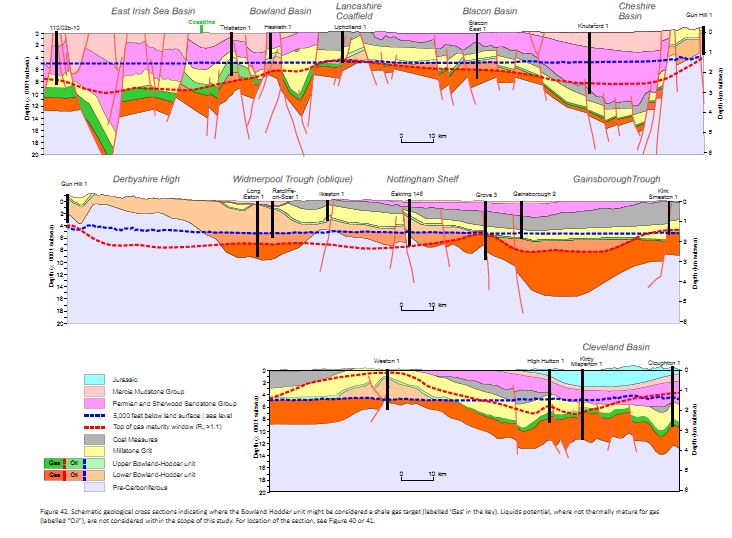
The aforementioned horizontal shale layers imagine the geology of the UK as some kind of layer cake, with one layer of sediment being deposited upon another.  There are such places on Earth where this does occur (Permian Basin in Texas is a good example) but the UK is not one of them.

The cross section above shows the structure of some of the geological basins that are potential targets for fracking in the north of England (Copyright DECC, 2013).  Even at this simple level, the potential complexity of the basins can be made out.  As one investigates on the local level, the complexity increases.

As always, the devil is in the detail.  Or facts, as they are otherwise known.  The fact is that every geological prospect is different and without having the geophysical data, and the knowledge of how to interpret it, it is not possible to know whether this 1200m safety limit is enough.  For example, if the fracks reach a porous layer of rocks above, there will be nothing to stop fluids reaching higher levels or even the surface.  This is where good surveying and the highest of standards come in.  In my long experience of working in the industry, most companies and individuals I have had the pleasure of working with have excellent standards.  Things can and do go wrong however, despite the best of measures.  This is why that, in the previous Coalition, the Liberal Democrats introduced the ban on fracking within national parks and under environmentally-sensitive sites.  It is this ban that the government is due to overturn in a Commons' vote today.  The 1200m safety limit is a barely minimum standard anywhere, never mind a national park.

Out of interest, what will the effect of drilling from outside the nation park actually allow?  Most people outside the industry may imagine that well bores go straight down.  This has long not been the case.  Drilling strings are steerable, allowing wells to be drilling even horizontally, should that be necessary.  The advantage to this, especially for fracking, is that a hole can be drilled along the target formation, maximising hydrocarbon production.
There are technical limits to horizontal drilling.  The longest wells rarely go past 8000m so, if one were to site a drilling rig just outside a national park and the geology allowed, this would be roughly the maximum extent of intrusion possible into the park.  However, if a combination of wells are used, it would be possible to set up network of interacting wells underneath a given target, allowing for large areas of fracking to take place under any given terrain.   This would effectively negate any benefit of national park protection if they become ringed with heavy industrial sites.

The government has announced that allowing fracking under national parks will "kickstart" the industry in the UK.  This is rubbish: what will kickstart any oil and gas exploration is the market price of energy.  That's it.  There is effectively nothing that any government can do to encourage fossil-fuel exploration while energy prices are low.  These prices are not due to recover until towards the end of the current parliament's term.

What are the Conservatives doing then?  They understand how markets work.  The measures are preparing the groundwork for when the oil and gas prices recover.   Oil companies obey the rules though: if they are told not to drill under a national park, they won't.  They will explore areas open to them.  Therefore by opening up the national parks to development, Conservatives are following another agenda, that of deregulation of the state over corporate action.

I have blogged before on the continued deregulation of the UK's energy markets by the Conservatives and it is disturbing that while they talk about energy security, in reality they are doing absolutely nothing about it.  The opposite in fact: by ending subsidies for renewable energy, they also prove that they care nothing for CO2 emissions or the resulting climate change.

I see nothing particularly wrong with fracking but it has to be regulated and monitored.  Instead the Conservatives are turning towards deregulation and free markets, regardless of the possible consequences for either the UK or the rest of the world.

Saturday, 10 October 2015

Terminated

In the past fifteen months, I have twice been made redundant.

The first one was actually easier to bear because I knew that my direct line manager had it in for me.  I was effectively working alone, not in an office so it was relatively easy for him to direct the flow of information.  Unlike others, I was not asked to reapply for my post but instead transferred across to a new cost centre within the company.  What I did not know is that was one due to be cut once the contract I was working on came to an end.  After what was to become my final job, I was called into the Stavanger office and by conference call my employment ended there and then.  No discussion or chance of appeal.

Working as I was, officially out of Italy, posted in Israel but for the last two years on secondment to Norway, I did not challenge the legality of the decision.  Which national court would I apply to for starters?   It was unpleasant but in a way okay because it was personal animosity on his part.  It was not my job performance: I knew what I did and did it well. I was the first out the door but soon many of my former colleagues were also unemployed and the industry started its decline.

Within seven weeks, I had joined a new company and I really enjoyed my time with them.  It was also convenient: usually one has to live within a major oil town to live close to such a job.  In was remarkable that I found one in Edinburgh less than a couple of  kilometres from the house.

Losing this last job is a lot harder to bear because I actually liked the people I worked with and I liked the work.  So to be judged as lacking compared to others who joined about the same time is a pretty bitter pill.  I guess at my age I am a slower learner on what are very difficult-to-use computer systems (we are not talking Apple or MS Windows here!).   I was partially hired for my previous industry experience but that does not seem to have mattered much when it came down to the crunch.

The worst thing about this time is that the whole industry is down.  As a noted in a previous blog, there are huge redundancies ongoing across oil and gas on a global basis - 65,000 around the North Sea alone.  The problems have been compounded here by the Conservative government's slashing of support for renewable energy.  An area that may have been natural for people in my position to transfer sideways into is also undergoing major jobs losses.

Unless something unexpected turns up, it looks like my time in the energy industry has come to an end.

Having undergone both the US-style same-day chop, and the British one-month staff consultation and selection process, which one is easier to bear?  Actually I think it is the American system.  It may be more brutal but the fact it is unexpected means the shock does not last as long.  Soon over and done.  The UK system of announcing upcoming redundancies, going through consultations and publishing the selection criteria may be fairer but it is unbelievably stressful for all those who even suspect they are in line to be axed.  The worst thing about it is the hope, the selfish hope that it won't be yourself but some other poor bastard.  I tried so hard to kill any hope but just could not.  As a society, we are expected to be positive and negativity is frowned upon.  It is almost impossible to stay positive under such circumstances.  Anybody who manages it simply does not care about the job they hold.

I was told yesterday afternoon that I was one of those who had been selected.  I wish I could have been more decent about it but that was beyond me.  Last night was pretty horrible.  It's the anger that is unable to express itself in some destructive outlet with is difficult to cope with.  Of course, it is this same anger when mixed with guns that leads to the explosive and tragic violence that is seen in the United States.  But it is the impersonal system that is at the root of the matter.  The people who sacked me are lovely - it would be better for my own sanity  if I could resent and hate them.  I have little doubt that their methodology was fair but the outcome is only for the company's benefit:  it does not feel at all fair to the people who have lost their jobs.  The whole process is easier on those who make the decisions and of course feels better for those who stay on.

It is  perhaps word-association that led me to think of James Cameron's movie The Terminator.  I had never thought of it as an allegory before but really it is.  Human beings develop a system that turns against them with an implacable and relentless logic.    Humanity is no longer necessary to the system and thus they are subjected to termination.  It is our creation of systems that have their own logic, without regard for the human impact, that necessitates the need for such a concept as "fairness".  Within the terms of the industry, my former employers are being very fair and above board.  It is the system as a whole that is not easy on people.

One thing that is definitely not fair is the government extending the period where new workers have no employment rights to two years.  I have invested over a year in this job and effectively have no rights whatsoever.  Six months is probably enough to see whether an individual is on the right track for a given job; a year is ample time.

I have to admit I did freak out a Texan friend when on Facebook last night I put up the status: "I finally understand The Terminator".  Her reply was "Wow.  Stay gold Ponyboy.  Stay gold."

I'm trying Shannon.

Oh, and if anybody would like to offer me employment, please get it contact.

Saturday, 26 September 2015

Conservatives and Their Lack of Energy

If one looks at the government website on low carbon technologies, from July one will find a flurry of activity.  All of this can be summed up in the government claim of controlling the cost of renewable energy.

You have probably heard that the power supplier Drax has announced yesterday morning they are pulling out of the carbon capture scheme, only one of two large-scale experiments (the other being in Peterhead), as a response to government cuts on renewable energy - in this case biomass fuel.

Likewise, support for small scale (less than 5MW) solar electrical generation are being withdrawn, and feed-in tariff support (that is the payments made for solar-generated electricity by small-scale suppliers) are being slashed and ended early.  Hundreds of small firms, importers and thousands of households that have already installed solar PV, and who were relying upon the goodwill and constancy of government policy have been ruthlessly betrayed.

Add to this also the Conservative's decision to block all onshore development of wind turbine technology and cut support for offshore wind farms, one can only conclude that it is all-out war on renewable energy itself.  Pretty much every green policy introduced by the Liberal Democrats during the last parliament is under attack.

That being the case, let's instead see what the Conservative's favoured technologies are.  Fracking and nuclear.

Now, I am not against fracking per se, as long as high standards and correct oversight are put in place.  In that, as I have blogged before, the Collation record was not bad at all.  That has changed since the Conservatives has returned to single-party rule; reversing decisions to protect national parks for instance.  No matter: Unfortunately, especially for those of us who work in the oil energy, the bottom has fallen out of the market.   The oil price has literally halved since last year.  This is good news for energy consumers (aren't we all) but at these times it means that the industries invest nothing into exploration.  Last week the Telegraph reported that in the North Sea - and I am taking this to mean for the entire basin (UK + Europe), 65,000 jobs have gone.  This would be about right.  For example: yesterday it was leaked that major oil service company Halliburton will be announcing a second round of cuts within the next two weeks; this being in addition to the 14,000 jobs they have already shed.  I am still in the industry but hanging on by the fingernails: my employer are cutting staff by thirty percent and there is no guarantee this is going to be the end of it.   OPEC is predicting the oil price will return to eighty dollars a barrel but not before 2020, while the great vampyre squid, Goldman Sachs, is now in bear mode, predicting that the oil price will remain low for the next fifteen years.  Frankly I don't believe that though.  Goldman have always played their own game.

One should also note that the fall in the fossil fuel price means lower consumer prices, therefore the burden of the renewable fuels levy is lessened as prices fall overall.  Since the Conservative cuts were announced in July after the price has fallen, it rather goes to show that the claim of reducing the burden upon the consumer is a red herring: the markets are making it happen anyway.

The last bit of the jigsaw is nuclear.  On this the Conservatives have sought to buck the market by guaranteeing the £2billion investment by the Chinese, This is only part of the total £24billion that the new Hinkley Point C power station, led by French company EDF.  All this is done with guaranteed (and high) prices for the electricity due to be generated.  Hinkley Point is just one of the  sixteen new nuclear power stations planned, all open to foreign investment.  One must assume that the government is also willing to underwrite other shortfalls in investment, plus allow for artificially high prices once the electricity is being produced.  Remember that a government underwriting  an investment means that any profits remain private, while losses are addressed from the public purse.

Both nuclear and renewables address needs just for electricity. Although it remains to be seen whether the Volkswagen diesel scandal will result in a profound change in direction, I cannot see electric cars dominating within the next fifteen years.  Some form of hybrid fuel use is more likely.  This is just for personal transport: long distance vehicles and marine transport will still be reliant on the sticky black stuff.

So what have we got?  Any form of local, small scale, renewable energy will soon no longer have support from the government.  Onshore wind turbines farms are out, and this effects the offshore market as well.  If their policies are allowed to continue, the Conservatives will kill the renewable industries in Britain.  Scotland has the political power to continue but is pretty well on course to be self-sufficient in renewable electrical generation anyhow.  In order for the process to effectively continue, England really has to be committed to it.

Similarly in oil and gas, fracking is not going to happen, at least for now, because of the low energy prices.  One might think that with the cutbacks and the low cost of exploration at this time, that now would be an excellent time explore.  It does not seem to work that way.  During downturns, energy companies just concentrate on the basics: cashflow and dividends first, maintenance after.  The cost of exploration and expansion comes out the surplus generated during high oil prices.

The low oil prices will also accelerate the decommission of the North Sea fields.  If the cost of maintaining the fields outweigh what they are earning, they will simply be shut down.  At this time, 140 (yes, one hundred and forty) fields are up for decommission.  This reflects the running down of the North Sea.  For both oil and gas, production levels are now under thirty percent of their peak levels in the late 1990s.

All this could be explained by the Conservatives perverse and short-term addiction to free-market economics.  It certainly does not add up to any dedication to the much-vaunted term "energy security".  Britain is already a net importer of oil and gas and under current policies that is only set to increase.

Why is it that nuclear is different?  What is so special about Hinkley Point C that those arch free-marketeers that are Cameron's Conservatives, feel the need to set aside up to £2billion of our money to ensure it goes ahead?  One cannot help but wonder if it has nothing to do with energy security,  for which the government seems not to care two jots about, and more to do with defence.

In 2010, David Cameron and President Sarkozy signed the Lancaster House Treaty, which provides for cooperation and close integration, not only between the two nation's military forces, but also joint supply and manufacturing.  The treaty is in force for fifty years so effectively by its end, UK and French military will be totally interchangeable.  Part of this process is nuclear forces.  Everything has a shelf life and nuclear weapons are no different.

Perhaps Hinckley Point C is to be part of this nuclear supply chain.  Who knows? We might even get some electricity out of it as well.

What is clear though, is that as far as energy supply and climate change, the Conservatives are content to leave all that to the free markets.  They simply could not care less.

No more pictures of Dave with huskies.  Given recent revelations with his interactions with other species, perhaps that is not a bad thing.

Wednesday, 2 July 2014

Fracking and Anti-Fracking.

Fellow Liberal Democrat, Tessa Munt MP, asked for views on the proposed government legislation to enable developers gain access to resources under private property.  Tessa is anti-fracking, so my response probably will not be a pleasant read for her, but below is my initial reply.

Tessa, I will make several points.

1) You are correct. Renewables should be the priority for the UK. It seems though that the British public are against ANY form of development of the countryside. The Conservatives are pandering to this by promising a ban on further onshore windfarm development if they win power after the next election.
Research and development of renewable energy, combined with government subsidy of improving the energy efficiency of our homes and places of work, should be a priority. Perhaps the stamp-duty tax and business rates of properties could be tweaked to reflect the energy efficiencies of properties, as well as giving positive support to make buildings more energy efficient.

2) In my view, and in the view of the British Geological Survey, 300m is too shallow. In a paper cited in my block entry on fracking, the BGS says that prospects under 1000m should not be explored and developed. Although some prospects in the UK come into this zone, most are between depths of 1000 and 3000m. I am against development above this depth and the law of access should reflect that safety margin.

3) You state that hydrocarbons should be left in the ground to reduce greenhouse gas emissions. True, but that is not happening. Coal is currently supplying 30% of UK energy, and those figures are rising, thanks to cheap imports from the US. Surely it is better to exploit cleaner gas reserves and leave the coal in the ground?

4) It is interesting that you mention the Coal Industry Act. This provides precedent under the law.
Can any individual really claim ownership of the ground over a mile below their property? Similarly, if we owned the sky above our houses, an overflying aircraft would equally be guilty of trespass. It is important that legislations does recognise damage and the level of evidence should not be criminal (beyond all reasonable doubt) but rather civil, on the balance of probabilities. A civil body, perhaps advised by the BGS, should be set up to independently evaluate any complaint. This should be funded by a levy on exploration companies involved in onshore activities.

5) Energy security. One just has to remember this simple fact. Since the late 1990s, levels in production of both oil and gas from the UK sector have fallen by two-thirds. Please see my blog for a graph based upon DECC production figures.
What is clear is that Britain’s main focus should be making good on this shortfall. We are currently a net energy importer and this situation is projected only to get worse in the next decade. http://www.fraw.org.uk/publications/e-series/e03/e03-uk_balance.png

To summarise.
I am all for government subsidy into renewable energy and energy saving in our nation’s buildings. We should investigate methods of taxation that reward responsible owners and disadvantage those who make no effort to improve their properties.

1000m should be the minimum depth of development, not the 300m cited in the proposed law.

In order to further decrease greenhouse gas emissions, usage of coal to generate electricity should be completely phased out as soon as possible.
Precedent for the proposed law already exists. An independent body, advised by the BGS, should be set up to evaluate damage claims. This body should be funded by a levy on the energy companies.
The status-quo is not tenable. If we do nothing as a nation, refuse to develop the opportunities open to us, we are effectively washing our hands of the matter and in importing more energy, we are paying cash to export the problem and our responsibilities.

If you wish to support Tessa's point of view, her website can be reached here.

My previous blogs on fracking for beginners can be reached through this link.

I fully intend to look over the government's consultation paper on drilling access and give a more detailed account later.

UPDATE

The day after I published this blog, the BGS published their Aquifers and Shales; a series of interactive maps showing the proximity of shale prospects to drinking water aquifers.  It is especially useful as it gives both plan and section views, giving the vertical distance between formations.  On the basis of this information, it is expected that drilling will be prevented where there is a risk to drinking water.

The site also gives details of their water-sampling project, which establishes a base line of the current methane content in the UK's potable water aquifers.  This is something that the US failed to establish prior to their fracking industry going ahead.