Showing posts with label libdems. Show all posts

Monday, 22 March 2021

Britain: Junior Partner and Authoritarian Future

 I am heartened that during the Liberal Democrat Spring Conference, held on the weekend, that both the party’s dedication towards the European Union has been reaffirmed, and we have come out fighting against the Government’s current crime bill that severely curtails the right to peaceful protest. Note the peaceful emphasis though. As I write this I am waking up to news from Bristol about riots as right-to-protest demonstrations turned to violence. There can be no excuse for that and I am very surprised to learn that there have been no arrests made overnight. What has led to such protests though was the Metropolitan Police’s heavy suppression of the vigil following the death of Sarah Everard. Peaceful protest is justified: burning of police vehicles and the infliction of injuries cannot be. 


The little bit of bright news that the party is still pro-EU is set against the big fat raincloud of the future as outlined by the current Conservative government. Unfortunately, what I have previously predicted is proving to be correct. Since the UK has left the European Courts of Justice*, the government is bringing about legislation that basically gives free range to police to ban any form of protest on the grounds of it being “deeply annoying”. Both Steve Bray (he of the top hat and megaphone outside Westminster fame) and Greta Thunberg (who on Twitter has since adopted the label "Deeply Annoying") would have certainly attracted the maximum fine of £2500 (or a year in prison) for solo protesting under the proposed law. Steve would have had an additional £5000 fine for directing a megaphone at parliament. Larger demonstrations, such as the one I witnessed in Aberdeen in January 2020 by Extinction Rebellion, are the main target of the legislation. Now, I don’t back ER’s aims (which involves a complete socialist takeover of all aspects of life) but I do support their right to peacefully protest. Did they disrupt business for the day in Aberdeen? Sure, but so what? Their message is important even if I do not approve of their proposed methods to save the planet. I think that the breaking up of the vigil in memory of Sarah Everard is exactly what current Home Secretary Priti Patel would love to see being used against ER’s Red Brigade. 


Extinction Rebellion in Aberdeen, January 2020

Another example of suppression of rights is embodied by recent criticism of BBC television presenter, Naga Munchetty who, along with fellow presenter Charlie Stayt were accused of making derogatory comments about the flag being used by Tory minister Robert Jenrick. Naga was later forced to issue an apology and there were calls online by at least one Conservative MP, Richard Kemp, who said on Twitter “The BBC must stop employing those who despise their own country.” I can assure Mr Kemp that mocking the Conservatives for waving bloody big Union Flags in the face of the public at every opportunity is not the same as despising one’s own country. Nor is opposition to this government, no matter how much one might indeed despise it.


The creation and crackdown against dissidents at home match the proposals for military expansion elsewhere. Although the Army is facing further cuts in numbers, the proposal to increase military spending by £80 billion should be seen as aggressive expansion of overall capacity and global power projection. The focus seems very much of the greater mechanism of the forces, with drones and similar remote vehicles seeing heavy investment, as well as the Royal Navy. To my mind, combined with our leaving the EU, means only one thing: the UK has picked a side and that side is with the USA, against everyone else. Remember that these plans were being prepared during the Trump administration and many on the right of US politics sees the EU, not as an ally and partner, but as a rival. So while the headlines are full of opposing Russia and China, ultimately they will be pointed at whoever the USA thinks is the greatest threat. Leaving the EU clarifies the UK’s ultimate loyalties, and they are with not with our nearest neighbours. As I write this blog, I am listening to an American admiral who while is bemoaning the proposed cuts to the Army, is very happy with the news that the UK’s number of Trident nuclear warheads will be boosted by forty percent. Wouldn't it be weird if representatives from other nation's military were to be invited on Today to comment upon the UK's future military plans? But it is perfectly normal for the Americans to do so and be given space on the BBC to air their opinions. 


There have been calls to adapt to these “new realities”. I don’t think I can. These are the exactly the types of developments that I predicted before leaving the EU. In fact, they are the only logic I can see to Brexit. Certainly there are political battles to be selected (and God knows, there are enough of them: poverty, handling of COVID19, jobs, the NHS to name but a few) but I cannot see any middle ground existing between those, like me, who are opposed to the UK’s current path towards being a junior partner in global superiority at the point of a missile launcher, and the government's path which will see continuing suppression of human rights, both at home and across the planet; spawning a plethora of minor wars and continuing the cycle started by the 2003 invasion of Iraq. 


It is therefore important that the United Kingdom reengages with our near neighbours as quickly as possible. By reengagement, I mean rejoining of the European Union. At home there has to be agreement among those who oppose this militaristic path to find common ground against the Conservative right who are pushing through this agenda. It is no coincidence that the Conservatives want to see a return to First Past The Post for all elections held across the UK. It is the most undemocratic method of voting possible short of actual vote-rigging, allowing a government voting in on a minority an overall majority in parliament. 


2019-20 Westminster Representation under FPTP

The previous justification for FPTP was that it keeps the extremists out of power. That has now failed: the extremists are in office. I am certain that the Conservatives are banking upon Labour in their continuing support of FPTP but really, Labour has to step up, support a genuine system of proportional representation and take a bullet for democracy on this one. Otherwise with the Conservative FPTP voting majority in England, we are effectively facing the prospect of a single-state party for the UK, just as we currently have with (the slightly more fair voting system) has delivered power to the SNP since 2007. The key to both is the use of identity politics: independence for Scotland and freedom from the EU for English nationalists.


This blog post can be summarised with this: our democracy is in grave danger. It is vital that no further ground be ceded to the right and that ground lost is rapidly recovered. I genuinely fear for the future for the UK if this Conservative government win a further term. Don’t shoot the Lib Dem messenger Labour, but the country does need you to step up and provide genuine opposition and reform. We cannot carry on having our nation’s path set by those on the extreme right. That outcome will be too horrible to contemplate but we are now on the path to authoritarianism. 


*This blog has been updated on the 24th of March as I previously stated that the UK has left the EHCR. The Brexit agreement allows for provision to leave parts of the EHCR but this has not yet actually occurred. 

Wednesday, 14 June 2017

On the state of Scottish Nationalism and the SNP

I wrote this as a response to the large amount of negative comments I received on my Facebook campaigns page from SNP supporters during the 2017 Spring election campaign.   https://www.facebook.com/martinveartedin/

The problem with the SNP is their agenda is both popularist and regressive. How can this be? The popularise bit is easy: free tuition fees, free proscriptions, opposition to London. Regressive insofar the government is purposely not using available powers to change the Westminster (Conservative) agenda. Sure, the SNP will block the bedroom tax (good) and not hand on the tax cut to higher earners (okay) but will not actually make profound changes. Ah, one might say, Barnett does not allow for Scotland to earn more that the given share. That is true, but it is totally possible to re-jig the tax system, with powers available, in order to put less of the burden on poorer tax payers and a higher burden on those richer. This is not being done nor is it likely to be. It is as if the SNP leadership are eager to pass on hardships while not using powers to ease the pressure on the people of Scotland. A cynic might say this is because that it would not be in their party interest to improve matter. Instead, the situation have to decline further in order to convince more people to vote Yes in the next referendum for independence. Consider the ongoing cuts, confirmed by such bodies as Audit Scotland for education but denied by supporters. The usual technique is to narrow the window of examination and thus present statistics in a narrow window that lets through the best possible light. Oil production is another such field were the larger picture is never presented.
Liberal Democrats support federalism. That is using devolved powers in order to improve things as close as possible to local communities. The SNP do not trust people. If they did, they would allow a diverse Scotland to emerge. Instead, we see a centralisation of power to a handful of minister in Holyrood. The police and emergency services are an obviously case. I shared a hustings stage with Kenny MacAskill in 2011 when he was musing why shouldn’t education be centralised? The popularist freezing of the council tax made councils more and more reliant upon funding by central government. Democracy has been slowly suffocated by the SNP and, while bemoaning the powers that Westminster have, power in Scotland has been increasingly sucked into Edinburgh.
Yet the SNP is not a party which encourages scrutiny and debate. It is a party of faith. Faith that only independence will solve our problems. If only we were independent, then we would be free to address the monumental issues that we all face. Those issues are not really discussed either. In 2014, such issues would be “the will of the Scottish people” following independence.
The SNP are serious about independence and they are in a hurry. Therefore any method is acceptable in order to get people to tick the Yes box the next time around. It is a bit of a reverse of 1745. In that campaign, Bonny Prince Charlie had to win every battle. A single defeat and the war would be lost. Now, the SNP can lose every battle until they win just one. It is their haste, combined with their conservative political strategy, that will be their downfall.
I am not a natural unionist. As a half-Irish Catholic, unionism isn’t a concept I am fond of. My concern over the course of Scottish independence is the effect of sudden independence will have on people. I questioned the economic basis of independence in 2014 and, come, 2019, things are not likely to improve. The glimmer of hope is that of Brexit.
Brexit might, just might, provide the shortcut that the SNP are hoping for. If the Conservatives win on Friday and pursue a hard Brexit (that is making the UK an offshore free-trade zone and basically making us into an mini-me version of the United States), then there is a case of bailing out in a hurry, whatever the economic cost. Both parties though play identity politics. If one is not a supporter of independence, one has to be a unionist. This is a false logic, for in ceding one’s identity, one hands over one’s critical faculties to others. Such-and-such is necessary in order to achieve the ultimate goal. All will be sorted out after victory.
So what must be done? The answer is simple if naïve: work for the good of people. Change society from what it is now. The SNP follow Westminster’s line in the hope that line will ultimately snap and with it the Union. Instead, we have powers, available now, to make a difference for good. If those powers were used and a track record achieved, this would result in one of two things. Either the rest of the UK would look to Scotland as a leading member of the Union and demand that they follow our example, or, they would continue to go their own way. If the latter, the case for Scottish independence would be made.
Neither course will suit the SNP though because it takes time, for it is the path of evolution rather than revolution. They want power and in a hurry, regardless of the effect upon us all. Instead of working to improve the prospects for the entire UK, they have given up on ever making a positive change and, instead, claim to just care about Scotland. If they really did care about us, then they know that improving the whole of the UK is just as important because, through simple geographical fact, there is no separating the reality of the links: cultural, scientific, economic. England will remain our largest trading partner, forever. Whatever happens in Westminster will always affect us here. So do we work together to overthrow the cycle of the two-party state or go it alone? The SNP has already answered that question: go it alone, regardless of consequences.

Monday, 2 May 2016

Five Questions: Broughton Spurtle

1. Edinburgh, in my opinion, has some of the worst new building in Europe. Why is planning law is so slanted towards the developer when decisions arising may put the UNESCO World Heritage status at risk? (My specific concern as local resident is the RBS proposal to develop the site bordering Eyre Place, Dundas Street, Royal Crescent, Fettes Row, Dundonald Street and overwhelming King George V Park. The RBS proposals suggest overdevelopment of the site that will place unrealistic pressure on local services and the environment.)

One of the biggest challenges facing communities in Edinburgh is fostering any sense of social awareness among developers.  I was speaking to the Cala during their public consultations over the 450 proposed dwelling places opposite the Ocean Terminal site.  I asked them about extra medical facilities required by the increase of population.  The answer was that this is very much a matter for Edinburgh Council.  They were however more willing to take on board my comments about any lack of play facilities for young children and keen to focus on minimising the traffic impact.

This last point shows that developers address the issues that planners address.  They know that under the current system, public views rarely matter: it is the council planning committee that they have to satisfy and that is everything.  Another example would be the redevelopment of the Edinburgh Academicals stadium in Stockbridge.  The local residents are overwhelmingly against the scheme as it stands but it is being pushed through by the council nonetheless.  It seems that the threat of losing the next election is not enough of a threat to hold over politicians.

This is something that perhaps can be addressed by the Scottish Parliament.  When it comes to housing, the first thing I would look at is housing density.  There are minimum standards for room size here in Scotland but I am not aware of any minimum standards of dwelling density.  It is in a developer's interest to maximise the return.  It is in the power of Holyrood to set maximum numbers of dwellings in a given area for a given city zone if the council is not providing suitable local standards.

The right of counter-appeal can also be looked at, although there are dangers if this becomes too powerful, resulting in neighbourhoods refusing any form of development.  Some may say that the Edinburgh trams should not have gone ahead at all but imagine if each neighbour the line goes through had to grant the scheme access.

The main point though would be to make any appeals scheme affordable.  At the moment, the residents of Stockbridge have only the option of spending tens of thousands of pounds if they want to launch a judicial review.  That probably is not going to happen.

As for the point over UNESCO World Heritage status, I have mixed feelings on this.  True, it does identify areas of outstanding character across the world (thus bringing in tourism and revenue) but some cites complain that it also halts necessary development.  Now I am not saying that Edinburgh is getting it's planning right; just highlighting the potential conflict between UNESCO standards and city needs.

In the end, cities are for people to live in.  Not just for the people already there but also for those who need to come and live here.  It is the politician's job to find the best way through the possible areas of conflict.


2. What concrete measures will you put in place to alleviate poverty and inequality in Scotland?

As a Scottish Liberal Democrat, I believe that not only should every person have equality of opportunity but we as a society should be there for whenever a person seeks to do better for themselves and their family.

The key to this on an individual level is education. Scottish Liberal Democrats believe that education is the first and arguably most essential investment when it comes to tackling any form of  poverty. That is why we have proposed a Penny for Education - a penny on income tax to enable investment in a transformation in Scottish education that will make it the best in the world again and enable people to get well paid jobs. This is fair because the rising personal allowance will mean that anyone earning under £21,500 will actually pay less tax next year. Those at the top will pay 30 times more than someone on an average income.

For those already in work, we have sought to ensure work pays and that the system is fairer to those on low and middle incomes. In government we raised the income tax personal allowance, cutting the bills of 2 million Scots by £800 and lifting 2.7 million across the UK out of paying income tax altogether.

We will pay the Living Wage for all public services and stop giving government grants to companies that don't pay the Living Wage. The Scottish Government has given £5 million to Amazon, even though it pays its workers more than £1 less an hour than the living wage and there have been real concerns over working conditions at their base in Dunfermline.

Scottish Liberal Democrats have committed to working with the other parties and stakeholders to ensure that the new Scottish welfare system is fair to those in and out of work and has the full confidence of users.

I believe that fuel poverty in a major issue in our city and across Scotland.  Liberal Democrats will work with other parties to see the energy efficiency of our nation's entire housing stock, not just new builds, but all our nation's homes improved.  This will be a major, long term project but a necessary one.  If we leave this to the free markets, it will never happen for all.  The nature of Scotland's housing, especially for the older buildings, means that there are people living in older property will can never really afford the major improvements required for their homes to truly become energy efficient.  As we undergo the transition towards a low carbon, more energy efficient future, it is important that our homes and, indeed, our businesses too, are fit for purpose.  Frankly, we are a northern nation but previous generations of regulators and builders did not seem to appreciate this, especially when it came to mass-market housing.


3. Tonight, women and girls in Edinburgh are afraid to go out in the dark alone. At this moment, women here are afraid to stay in their own homes, through fear of violence and abuse. What specific measures will your party bring forward, in the next parliament, to ensure that women and girls in Scotland are safe in their own homes, and are able to go out freely and confidently into the world? What will you do to stop women in Scotland living in fear?

At this election, Scottish Liberal Democrats are proposing among other things to:

Introduce a new offence of domestic abuse

Support early intervention with those at high risk of first-time offending

Take major action to improve conviction rates for sexual offences, including consideration of legislation to allow research to be undertaken with jury members; the right of juries to be able to ask questions of expert witnesses or the provision of an expert adviser to assist juries with expert evidence, together with suggestions made in the Bonomy review.

Legislate to prohibit physical punishment of children. The evidence from dozens of studies is now indisputable on what our law describes, in Victorian fashion, as the "justifiable assault" of children.  It damages their wellbeing, increases aggression and antisocial behaviour which can continue into their adult lives, and risks escalating into physical abuse.

My colleague Alison McInnes, the Scottish Liberal Democrat justice spokesperson, did a great deal in the last Scottish Parliament to help protect women and girls from violence and abuse. You can read a recent speech she gave on preventing violence against women at http://alisonmcinnes.co.uk/en/article/2015/1125822/speech-on-violence-against-women-16-days-of-activism.

My personal view is that some of it comes down to early education, both in schools and in the examples from parents and carers.  Some people, usually but not exclusively women, are simply more vulnerable to abuse.  Recently schools have done a great deal to tackle bullying in our schools but until we live in a society where signs of weakness does not trigger an oppressive response in some others, the challenge will still be ongoing.  Peer pressure has a lot to do with this.  When it is not done for a group member to cat-call or abuse a passing stranger in the street and the peers turn upon others for doing so, progress will have been made.  We do not yet live in such a society.

4. In the light of the current PPP scandal, how do the candidates see future funding for large infrastructure projects?

Following the schools crisis here in Edinburgh, Scottish Liberal Democrats have been calling for a full inquiry into how we got to this point. We would also make the companies that build and maintain our schools and hospitals subject to freedom of information laws so that the public can check they are being run properly.

Our fully costed manifesto sets out the infrastructure projects we plan on taking forward and how we will pay for them. For example:

We will establish a Fit For The Future Investment Fund, drawing on the earmarked resources from half of the Scotland Act borrowing powers (more than £200 million a year).

Action to reduce the persistent underspending of the Scottish Government's budget to ensure underspends are redeployed into other projects that are waiting for the green light.

The Scottish Government's capital budget is increasing.
Our Help to Renovate loans will come from the special financial transaction consequentials in the Scottish budget.

We will expand the Housing Fund for Scotland model that has seen investment in rented homes pioneered by a local government pension fund.

In view of Liberal Democrat commitment to local democracy and councils being responsible for raising and spending funds locally and transparently, I would be open to ideas on other alternatives, such as funding of city projects through the issue of bonds.

5. Although the independence referendum was the occasion for great political involvement, it has also led to a very polarised political environment in Scotland. (As anyone who follows social media will be aware!) How do the candidates intend to heal the political divisions of post-referendum Scotland if they are elected?

As far as I am concerned, these elections are about the best delivery of services and improving the standards of living for everybody living in Scotland.  It most certainly is not about a second referendum, which is what the SNP want to make it about.  Nor is it about cries of defending the Union, which is what the Conservative party would have us believe they are about.  Both of these parties are cynically exploiting and deepening the polarisation which the question, correctly, refers to.

We are living in exciting times here in Scotland and we have an opportunity to use the new powers coming to us to make a real difference to all our lives.  We can show the rest of UK that there is a different way to do things than the old Labour - Conservative Punch and Judy show but, to my mind, nationalism is not helping in this.  It is, in fact, a distraction from us as a society making use of the the powers we already have.

I say that instead of blaming others or calling upon any form of jingoism, let us focus on the task at hand, right now.  Goodness knows they are big enough.  Education, housing, the NHS and a myriad of others, just as vital.  How does either cries for either a second independence referendum or claims to be the protector of the Union help?  They simply don't.

If on Thursday I were to become your MSP, my pledge would be to focus on the issues, encourage others to do so, take responsibility for our own actions here in Scotland and work, constructively and transparently, with others in finding and delivering fair, democratic and liberal solutions for the people of Scotland.

Friday, 29 April 2016

Seven Questions. Greener Leith.

1. In your opinion, what is the most pressing environmental issue facing the Edinburgh Northern and Leith constituency?

The two most pressing environmental issues facing the constituency is cleaner transport and warmer homes.

Of these, the transport one is the easier to tackle.  We can encourage cycle use by upgrading cycle lanes on streets, like Leith Walk and Lower Granton Road, wide enough to handle them.  26,000 people live with 800m of Leith Walk and in storage right now, there is enough materials to have the trams run to the Foot of the Walk.  Let's get on with it.


2. If elected, how will you use your role as MSP to encourage the Scottish Government and Edinburgh Council to improve how they work together on environmental issues facing this constituency?

Edinburgh Council is currently undergoing severe levels of cuts and while the Scottish Government  always demand more services, it's no good if there is no funding for the changes.  Liberal Democrats would free councils to raise and keep more money to spend in their local communities instead of having to be dictated to by central government.
If elected as your MSP, I will ensure that I keep good lines of communication open with Edinburgh Council. It is important that each level of government understand each other and, despite any party differences, common ground is found to work together for the good of all.

The main environmental issue affecting the city (and nation as a whole) will be to bring up the energy efficiency of our existing homes.  We will need transparent communications between central government and local authorities to achieve this.

3. How will you use your role to inspire and encourage greater pride and civic engagement in our public spaces?

It would be great if we have more of them!  We really need more green spaces and play spaces  incorporated in the new residential plans for the Port of Leith.

What parks that we have are well used and I would be sympathetic to turning over more space to allotments.  This is already been done in Victoria Park for instance.  For public health and fitness, I would also like to see more outdoor gyms, as already exist in Musselburgh and Silverknowles.  These can be put into quite small spaces that would otherwise be neglected.
I want to see Stedfastgate brought back up to some form of good use.  The fountain monument there has been vandalised, brick paving ripped up and seating damaged.  If areas like these had some form of dual usage then they are more likely to be appreciated.

4. When local issues are so important for many constituents, how will you ensure that the global issue of climate change, and our impact, is always kept front of mind?

I spent twenty years travelling the world in energy so know the reality of global energy generation first hand.  We live in exciting times however because even the industry itself realise that the time of oil is drawing to the end.  Our energy is moving over to electricity and that means more local generation.  It does not mean however that Scotland is isolated from the rest of the world.  We will be still importing gas for the next twenty or thirty years while our renewable industry grows.  Scotland will still be a part of the UK and European-wide power network and will, at different times, be an energy importer and exporter.
It is for these reasons that Scotland cannot be isolationist in outlook.  How the UK and Europe generates energy will continue to affect us and greenhouse gas emissions, regardless of what we do here.  We have to continue to take an interest in the global energy picture.


5. Which environmental policy do you think the current Scottish Government has been successful at implementing over the last 5 years, and which policy could do with some improvement?

Liberal Democrats do welcome the start made by the Scottish Government on land registration, with private land being registered by 2025 and public land by 2020.

I wish I could be more generous but I can't think of another damn thing that has been successful.  Great and ambitious environmental targets are set but are never reached.  The Scottish Government has a statutory duty to eradicate fuel poverty by November 2016. It refuses to accept this is going to be missed despite the fact a third of households (845,000) are in fuel poverty. In some rural and remote areas (Orkney for instance) it is almost two-thirds.
I have been at hustings where the SNP claim that the nation is on target to meet our renewable heating targets by 2020.  The target for that year is 11% and currently we are at 3% renewable heating production.  How is that even near being "on target"?  If we are going to be anywhere near the 40% target set for 2030, we have to move on this immediately.

If the SNP are serious about reducing Scotland's greenhouse gas emissions, why is it that at a Spectator event here in Edinburgh on the 28th of April, George Kerevan MP, SNP representative on the Treasury Select Committee, appeared on stage with Gordon Dewar, chief executive of Edinburgh Airport, and agreed to half tax on Air Passenger Duty by 2018?  Anybody with environmental awareness knows that that air travel is the worst method in terms of greenhouse gas emissions and that aviation fuel is otherwise untaxed at any level.


6. Where do you stand on amending the current law on ownership of Scottish land or property by overseas companies to say that the land must be owned through a UK registered company or other organisation? (E.g. Much of the ownership of brownfields land in the constituency is by offshore companies who are hard to trace.)

The law needs changing.  Where I live in Newhaven Harbour, I look over the brownfield site whose exact ownership is only known to the lawyers involved.

Liberal Democrats will work with other parties to ensure:

An effective and transparent land register for Scotland

We will work with other parties to establish fair taxation based upon land value in order to replace the council tax.

Liberal Democrats would like to see the right for local communities to purchase land extended to urban communities, and especially applied to neglected or abandoned plots.


7. What is your stance on equal rights of appeal under the planning system? Currently only planning applicants can submit appeals, not councils or other community organisations.

I see the need for reform, especially when councils fail to represent the views the local community.  The redevelopment of the Accies site in Stockmarket was railroaded through by the council in the teeth determined local opposition.  In these circumstances the local community should indeed have the right to appeal and that any process should be affordable.

Local communities cannot have the right to veto in all circumstances however.  Now it is debatable whether the trams were a good idea or not but imagine if each neighbour had the right to appeal the route.
A balance is required between local effects and greater needs.  Thus the effects of a retail development (such as Accies) is local and should be able to be appealed.  I would want to look at the effects upon developments that have wider applications and am open to ideas on the issue.

Friday, 8 April 2016

Letter to TRIM and West Pilton

At the kind invitation of the Chairman of the Tenents and Residents of Muirhouse  and Friends of West Pilton, candidates are invited to write an open letter to voters of the neighbourhoods.  

Here is my letter. 


Hello!

My name is Martin Veart and I am standing on behalf of the Scottish Liberal Democrats in our constituency of Edinburgh Northern and Leith.

The Liberal Democrats have been taking a bit of a battering of late.  I have stuck with the party because out of all the political parties, it is the only one that believes that government should serve people.  That is the core of liberalism.  Liberals understand we that know our own local communities best of all: knowing both the problems but also the opportunities to improve.  The Liberal Democrats want to return power to the most local level possible, to tackle the challenges that we face right now.

At this point I will do something that may surprise you.  I will praise the SNP.  Alone of all the  parties, they engaged and got stuck into the grassroots of civil Scotland: the residents' associations, the voluntary groups and respected community individuals.  They have raised hopes that have been long absent from the political scene.

It is the job though of politicians to deliver results and that is where the SNP have failed.  Edinburgh is undergoing continuing rounds of cuts: to the council (2,000 jobs), to the health and social services (wards being closed, Liberton Hospital due to shut and staff frightened into silence) and our educational facilities suffering from cuts to places and staff, resulting in overflowing class sizes.

It is little wonder that the only party that have consistently supported the SNP budgets over the years are the Conservatives.

During the post-Referendum talks, Liberal Democrats took a full and constructive part in the Smith Commission negotiations.  We helped bring back new powers to Scotland and we now want to use those powers to improve people's lives.  Not is some distant future, after a new referendum, but starting right now.

Our main policy to achieve this new start is a rise in income tax of 1p in the £.  The extra £450 million raised would be used this to invest in education: from pre-nursery to adult life-long learning.  Through the Pupil Premium, a policy Liberal Democrats have already delivered in England, the pupils who are most disadvantaged gain the most benefit.  For Scotland that means £1400 for each disadvantaged primary school child and £900 for each young person at secondary school.  The funding follows the pupil so if the family moves, the child does not lose out on resources.
The extra money will increase a child's chance of going on to further education and even to university.  In some neighbours in Scotland, a young person has more chance of ending up in a young offenders unit rather than at their local university.  That cannot be allowed to continue.
The 1p in the £ will see funding returned to pre-2008 levels, returning our education levels to where it used to be: among the finest in the world.

It is all very well providing our young people with a good start in life if, when they are looking for a home there is nowhere they can afford to live.  Edinburgh is in the mist of a housing crisis.  I want to see the plans for Leith and the Western Harbour reactivated.  The city needs more social housing.  We also need better planning in the city.  I have been listening to residents in Muirhouse and I understand it is not good enough building new homes if there are not the services for people to use.  People need nearby places to shop and shouldn't have to travel miles to find health facilities like GPs, pharmacists and dentists.  As your MSP, I will work closely with Edinburgh Council to ensure the services that people need are delivered and that new homes are built.

When it comes to health services, the Liberal Democrats want to see better treatment and availability for mental health problems.  Only one-in-four young people in Scotland suffering from mental health issues have their first appointment within the 18 week target.  There are over 50 children in Scotland who are waiting over a year for their first consultation.  For too long mental health treatment has been the Cinderella service of the NHS and that needs to change.  We will be listening carefully to Scottish health professionals how we can improve matters here, as well as drawing on the Liberal Democrat experience in England, where we have already delivered real improvements.
Liberal Democrats also want to see the end of criminalisation of drug use in Scotland.  Supply of illegal drugs would remain a criminal offence, with suppliers facing long prison sentences, but users are suffering from health and social problems and are not criminals for being addicts.  This approach have led to good results in Portugal, which, after fifteen years of following the policy, has seen a decline in drug use among the young.

Liberal Democrats value evidence-led policies and that is what we will deliver for the people of Scotland.  For more details, visit our website: http://www.scotlibdems.org.uk

I will just like to end upon a further word or two about myself. With my family, I live at Newhaven Harbour.  Previously I worked in oil and gas but, like many in the industry nowadays, I am now looking for new opportunities.

If one looks at the leaflets of any political party, each of them promise to supply a strong voice for the constituency.  Very good, but what does a strong voice actually mean?  Meekly following the party leadership, despite private doubts?  Not rocking the boat in case that means being overlooked for a ministerial post in the future?
My pledge to you would be to use my best judgement on every occasion: to listen carefully, to consider the issues and work for the best outcome possible for the people here.  I am a liberal to the core and as such I am not afraid to speak out on the issues: even to be point of disagreeing with the leadership, openly if need be.

In voting for me, Martin Veart, you will be voting for a person, not just a party.  In using your second vote for the Scottish Liberal Democrats, you will be voting for the party with wants use power to serve you, your family and the community.

You can contact me on mm.veart@yahoo.co.uk and my personal blog is at http://martinveart.blogspot.co.uk/


Saturday, 5 March 2016

Libdems and Fracking

The article below first appeared in Libdem Voice, 5th March 2016, in a slightly shorter format.

It seems that there is widespread misunderstanding among the federal party members as to why we here in Scotland decided to end the current moratorium we had on fracking and other non-conventional extraction of hydrocarbons.

Introduced in 2013, the Scottish moratorium on fracking was, as far as one understands it, based upon awaiting further evidence.  The following year, such evidence actually came to light in the form of the Scottish Government's 2014 report: Independent Expert Scientific Panel - Unconventional Oil and Gas.   http://www.gov.scot/Resource/0045/00456579.pdf
The report is comprehensive: addressing as it does both the environmental and public concerns.  It comes to the conclusion that, with proper oversight, public consultation and tight planning restrictions, that it is possible to exploit the United Kingdom's potential for future hydrocarbon exploitation.

It was upon the basis of this report that Ewan Hoyle of Glasgow put forward his amendment to end the moratorium on fracking.  At conference, I spoke in support of the amendment on the current state of the industry.  With the oil price currently around $36 a barrel, the North Sea offshore industry has already shed over 70,000 jobs, with the associated knock-on effects throughout the economy.

Ewan also outlined the costs of importing oil and gas abroad, outlining the additional carbon cost of shipping.  I would like to expand upon this point.


The graph comes from the report Potential Greenhouse Gas Emissions Associated with Shale Gas Extraction and Use, published in 2013.  It shows that shale gas compares favourably with both non-EU gas imported by pipeline and LNG (Liquified Natural Gas) which is the method of importation by tanker.

As an aside, I recently read Norman Baker's biography Against The Grain.  While in government he came forward with the idea of comparing the different forms of oil, gas and coal imports according to their CO2 signatures.  This would have been an extremely good way of helping non-experts (pretty much all of us) when it comes to question whether to import or produce hydrocarbons at home.  Naturally his idea was not accepted by our partners in Coalition

As Liberal Democrats, we can be united in wanting to see the end of global dependency on fossil fuels.  The fact that the UK will still be dependent upon them for the next fifteen to twenty five years has to be addressed.  The issues are not simple.

I want to add to this the issue of not just CO2, which is of course vital, but also that of safety.  To my mind, environmental concerns are global.  This was brought home to me in the mid 1990s by none other that the ecologist and botanist Dr. David Bellamy.   After he gave a talk, I asked him what he thought of the North Sea oil industry.  His answer surprised me.  David Bellamy regarded the North Sea has having the best and highest safety regulations and record in the world.  He said that one had to be very careful in campaigning against oil and gas extraction and gave the example of Conoco in Central America.  Conoco had obtained licences to drill in part of this nation's rainforest and had prepared careful plans to do so with the minimum of ecological impact.  The green campaigners in the USA strongly objected and launched a huge campaign to stop Conoco drilling in the rainforest.  The Greens won: Conoco decided that the adverse publicity was not worth it and withdrew.  Big celebrations among environmentalists.
That still left a poor nation with an unhappy government determined to do its best.  What happened after Conoco pulled out was the government granted licences to some two-bit drilling outfit who didn't give a damn either about its public image and even less about the environment.  The new operators trashed the place.

Since then, I have been working in the oil industry, very much at the sharp end and all over the world.  I found Dr. Bellamy to be correct: the North Sea basin (United Kingdom, Norway, Germany, Denmark and The Netherlands) is collectively the best, the safest, the cleanest and most regulated oil and gas basin in the world.  Outside Northern Europe, the industry is patchy.  Some of the oil majors do manage to uphold high standards throughout their global operations.  Others say they do, while if the crunch comes and an incident reported, the move is not to investigate but to cover up.
This ought to show that if we in the UK do not use our own expertise, under our own regulations, to the standards applied to the offshore industry, but yet continue to import oil and gas from other parts of the world, we don't really care about the environment.  What we don't know may not upset us but we will be doing nothing to reduce CO2 emissions, accidents and pollution elsewhere.

So it saddens me that we have an email Willie Rennie saying that the policy committee has decided to oppose fracking on the grounds of climate change.  As I have outlined above, this would be factually incorrect and smacks more of popularism than policy.  This drive is from top-down and does not reflect either conference decision nor understanding of the issues.

In campaigning, messages have to be simplified.  What should never, ever happen is that the message dictates the policy.  I get that fracking is not popular but for us to examine the evidence and then campaign against what the evidence says is frankly perverse.  That is one bandwagon that the Liberal Democrats should never jump on.  To do so may lead to some short term success but it will inevitably lead us being hollowed out morally as a party.  The last thing we need to adopt is an opportunistic culture.  Liberal Democrats need to be evidence-based.

Winning is important but if the leadership starts reversing conference decisions because they are politically inconvenient, we have to ask ourselves: what kind of party are we becoming?


Wednesday, 30 December 2015

Why are you a Libdem?

Recently a email was sent out to members asking this question.  So why am I a Libdem?  Not for the naked quest for power and the high life: that is for sure.

Anyhow, below is my more considered response.

For me, being a liberal means being decisions being made at the most local level possible.  It means encouraging people to take an active role in our own communities and not being dictated to by central governments in either Westminster, Cardiff or Edinburgh.  That means getting involved: whether directly in politics or voluntary work with your local community.

At the centre of liberalism is you.  It's me.  It is every individual for government should be at the service of everybody.  If a family is trying to get good health care or education, then it is the government role to ensure that people are helped.  It isn't about leaving the vulnerable behind.

Liberalism is also about business.  We realise that while no one method if wealth generation is perfect, capitalism is the most effective way of generating a decent standard of living for all; only though if it is properly regulated.  People have to have a sense of ownership, of responsibility and successful risk should be rewarded.  Business too have responsibility to the communities in which they operate.

Government is responsible too: responsible for law-making, regulations, infrastructure, national and international relations and defences but also responsible for ensuring that our armed forces are not deployed in unjust and open-ended wars.  Working constructively with all our neighbours is the best way so despite its flaws, that is why most liberals support the work of the United Nations and the European Union.

This local-to-global outlook means that liberals also care deeply about the environment.  We see that with growing populations that our planet's ecosystems and wildlife are under great strain.  We go where the evidence leads us and that sometimes means hard decisions and having the courage to stand by them.

In summary, being a liberal means standing up, taking responsibility, accepting people as we are and working to get the best outcome for all.

To give your own reason why you are a Libdem, follow this link

Wednesday, 16 December 2015

Fracking Under National Parks

One noted the care taken in the choice of words from the government spokesman when he talked about "horizontal shale layers".  This was in reference to the government vote today on whether to allow fracking underneath environmentally sensitive sites.  The spokesman went on to mention that the limit on measured hydraulically-induced fractures (or fracks, as I shall call them for the rest of the piece) is 600m, so that a safety limit of double that difference, 1200m, will be safe enough.

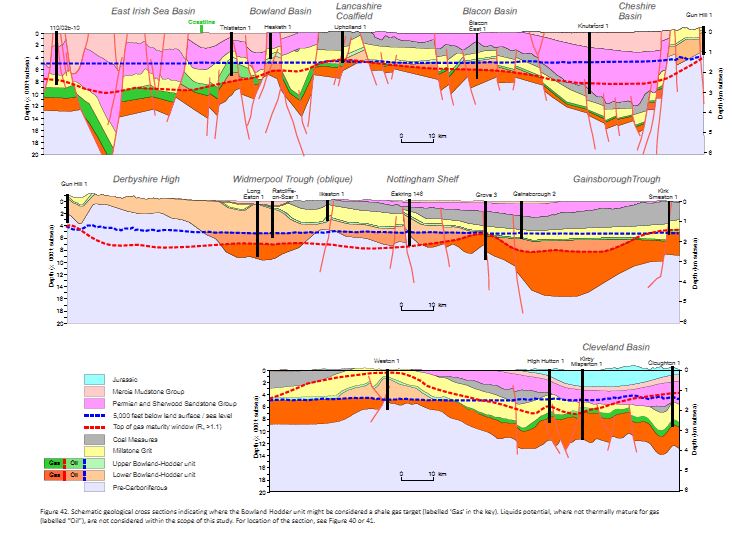
The aforementioned horizontal shale layers imagine the geology of the UK as some kind of layer cake, with one layer of sediment being deposited upon another.  There are such places on Earth where this does occur (Permian Basin in Texas is a good example) but the UK is not one of them.

The cross section above shows the structure of some of the geological basins that are potential targets for fracking in the north of England (Copyright DECC, 2013).  Even at this simple level, the potential complexity of the basins can be made out.  As one investigates on the local level, the complexity increases.

As always, the devil is in the detail.  Or facts, as they are otherwise known.  The fact is that every geological prospect is different and without having the geophysical data, and the knowledge of how to interpret it, it is not possible to know whether this 1200m safety limit is enough.  For example, if the fracks reach a porous layer of rocks above, there will be nothing to stop fluids reaching higher levels or even the surface.  This is where good surveying and the highest of standards come in.  In my long experience of working in the industry, most companies and individuals I have had the pleasure of working with have excellent standards.  Things can and do go wrong however, despite the best of measures.  This is why that, in the previous Coalition, the Liberal Democrats introduced the ban on fracking within national parks and under environmentally-sensitive sites.  It is this ban that the government is due to overturn in a Commons' vote today.  The 1200m safety limit is a barely minimum standard anywhere, never mind a national park.

Out of interest, what will the effect of drilling from outside the nation park actually allow?  Most people outside the industry may imagine that well bores go straight down.  This has long not been the case.  Drilling strings are steerable, allowing wells to be drilling even horizontally, should that be necessary.  The advantage to this, especially for fracking, is that a hole can be drilled along the target formation, maximising hydrocarbon production.
There are technical limits to horizontal drilling.  The longest wells rarely go past 8000m so, if one were to site a drilling rig just outside a national park and the geology allowed, this would be roughly the maximum extent of intrusion possible into the park.  However, if a combination of wells are used, it would be possible to set up network of interacting wells underneath a given target, allowing for large areas of fracking to take place under any given terrain.   This would effectively negate any benefit of national park protection if they become ringed with heavy industrial sites.

The government has announced that allowing fracking under national parks will "kickstart" the industry in the UK.  This is rubbish: what will kickstart any oil and gas exploration is the market price of energy.  That's it.  There is effectively nothing that any government can do to encourage fossil-fuel exploration while energy prices are low.  These prices are not due to recover until towards the end of the current parliament's term.

What are the Conservatives doing then?  They understand how markets work.  The measures are preparing the groundwork for when the oil and gas prices recover.   Oil companies obey the rules though: if they are told not to drill under a national park, they won't.  They will explore areas open to them.  Therefore by opening up the national parks to development, Conservatives are following another agenda, that of deregulation of the state over corporate action.

I have blogged before on the continued deregulation of the UK's energy markets by the Conservatives and it is disturbing that while they talk about energy security, in reality they are doing absolutely nothing about it.  The opposite in fact: by ending subsidies for renewable energy, they also prove that they care nothing for CO2 emissions or the resulting climate change.

I see nothing particularly wrong with fracking but it has to be regulated and monitored.  Instead the Conservatives are turning towards deregulation and free markets, regardless of the possible consequences for either the UK or the rest of the world.

Thursday, 30 April 2015

Campaign Letters #2: Press Freedoms and Media Ownership.

Thank you for your email on media ownership and the abuse of power.

If I give you a long answer to a short question, please understand why.  For a politician to go charging into to a freedom of speech debate knowing all the answers is extremely dangerous.

Yes, my initial reaction on Leveson was to back the report in full and ignore the howls of complaints from the big media.  But when Ian Hislop, editor of Private Eye, joins in the criticism of the report, one should sit up and take notice.  Private Eye has repeatedly covered the stories that many other mainstream papers would not touch until there was no other option.  Any comment from it concerning press freedom is therefore worthy of the upmost consideration.

Liberal Democrats share the hope of Lord Justice Leveson that the incentives for the press to sign up to genuinely independent self-regulation will succeed. But if, in the judgment of the Press Recognition Panel, after 12 months of operation, there is significant non-cooperation by newspaper publishers, then – as Leveson himself concluded – Parliament will need to act, drawing on a range of options including the legislative steps necessary to ensure that independent self- regulation is delivered. Where possible, we would seek to do this on the same cross-party basis that achieved the construction of the Leveson scheme by the Royal Charter

On the phone hacking scandal and payment to public officials, there are already laws covering such issues.  Operation Elveden is making it clear that enforcing these laws and bringing successful prosecutions is extremely difficult.  I would be open to ideas to tighten up upon illegal acts committee by individuals; making the owning corporations and senior executives culpable in their responsibility.  At this time, it seems that claiming ignorance or a failure to recollect the facts are indeed enough of a defence.

As a Liberal Democrat, I believe it is vital to uphold freedom of speech.  Part of that process is that, in a democracy, people have the right to be wrong in the view of others.  This has to be balanced with responsibility.  The major question is to what and to whom?  My best answer are to the facts of a given situation.  Thus the responsibility of media should be answerable to presenting not the best, but the most balanced evaluation of available facts.

In order to protect journalists who pursue facts with the aim to uncover corruption, Liberal Democrats would:

Introduce statutory public interest defences for exceptional cases where journalists may need to break the law (such as RIPA, the 2010 Bribery Act, and the 1998 Computer Misuse Act) to expose corruption or other criminal acts.

Ensure judicial authorisation is required for the acquisition of communications data which might reveal journalists’ sources or other privileged communications, for any of the purposes allowed under RIPA; and allow journalists the opportunity to address the court before authorisation is granted, where this would not jeopardise the investigation.

Undertake a post-legislative review of the 2013 Defamation Act, which Liberal Democrats drove through Parliament, to ensure the new provisions are reducing the chill of libel threats.

Introduce, after consultation on the detail, the changes to the 1998 Data Protection Act recommended by Lord Justice Leveson to provide a fairer balance between personal privacy and the requirements of journalism, ensuring that the position of investigative journalists is safeguarded.


To guarantee press freedom, we will pass a British ‘First Amendment’ law, to require the authorities and the courts to have regard to the importance of a free media in a democratic society.
To nurture public interest journalism and protect the public from press abuse, we are committed to a system of accountability that is totally independent of both government and the newspaper industry, as set out in the Royal Charter on Press Regulation.

On media ownership, again it is in everybody's interest that a single individual does not become too powerful.  I did not want to particularly name an individual organisation but in the case of News International, it has been very successful in building up its own global power by putting itself and the service of the ruling elites of wherever it is operating: Fox News and The Wall Street Journal in the US, Sky News Arabia and, until last year, Star TV China.  I do not have to quote to you more local examples.

News International's global reach just shows how difficult it is for a single nation to uphold desired standards.  We certainly do not want any state of affairs that resembles that of Italy, when while in power Silvio Berlusconi was in control of the majority of private companies and as prime minister control the state media outlets too.  

The trouble is that, as Nome Chomsky pointed out in his book Necessary Illusions, big business owns most big media and thus has many more shared values to protecting the status quo than in depicting reality as it stands.

This leads us to the nub of the matter: the depiction of the facts.  A year ago I was asked to comment by a friend on a ten minute video presentation by film director David Puttnam, in which he asks the question whether the media has a duty of care towards the public.  My blog piece is here:
http://martinveart.blogspot.co.uk/2014/05/media-and-duty-of-care.html

Why media responsibility towards facts are so important is because it is where most people get their information from.  In the end, it has to come down to respecting facts and protecting those who pursue them.

If you have any further points you would like to raise, or indeed subjects, please do not hesitate to get in touch.

Yours sincerely,


Martin Veart
Scottish Liberal Democrats
Edinburgh North and Leith.


PS.  Unlike Labour, the Conservatives or the SNP, The Sun and Rupert Murdoch has never supported the Liberal Democrats nor urged their readers to vote for us.  I'm fine with that.  mv.


Tuesday, 27 March 2012

Farron vs. the ASA

Tim Farron, (Photo credit Telegraph Newpaper)
Yesterday there was a tweet-storm about Tim Farron, President of the Liberal Democrats, signing a cross-party letter of complaint to Lord Smith of Finsbury, the chairman of the Advertising Standard Authority after it was ruled that the advert  "NEED HEALING? GOD CAN HEAL TODAY!... We believe that God loves you and can heal you from any sickness." fell foul of ASA guidelines.  The letter can be read here as first published on the Total Politics blog site.


Technicalities first.  It is the ASA's remit to ensure that adverts are legal, decent, honest and truthful.  The problem with "Need Healing?" is that it is a matter of subjective judgement whether the statement is truthful.  If somebody has been healed, good for them but it is impossible to prove beyond the affirmation of witnesses to the event.  Owing to the subjective nature of the claim, the ASA is therefore correct to call for the leaflet to be withdrawn. If they did not, any advert would be acceptable, no matter how outrageous the claim.  The letter's call for negative proof is simply wrong-headed because the same standard has to be applied across all advertising.

Tim Farron has been subsequently criticised, with some not-so-veiled calls to overthrow him as party president.  These calls I do not share.  Tim is doing a great job in hard times for all of us; his talent, energy, enthusiasm and conviction are top-draw.  The party is fortunate to have him.  There are also those who have criticised Tim for believing that faith can heal.  I don't recall ever seeing a document where Tim says something like "don't take your medication because God will see you well."  To jump from one to the other is a leap than some are unfairly accusing him of.

What are more disturbing are the undercurrents; the implied question "should such a committed Christian be this high-profile role while still affirming his faith?"  Now I know that some Liberal Democrats are unsympathetic towards religious belief.  If one demands objective proof in every aspect of their lives, well that is their call.  One can see and respect the logic.  Others of us have subjective experiences which are outside objective proof and it is in that realm of the subjective that faith can be found.  Does that make a religious person less reasonable or more misguided?  According to some, yes.  What I would say to those then is judge the individual upon their results, as you would judge any other individual.

I have a mate who farms a small-holding in Cumbria.  He told me that he had discussed Tim Farron with others in the local pub.  During the discussion Tim was described as a "God Botherer" and his veganism doesn't go down well with sheep farmers.  But the consensus was "Aye, we'll vote for him." People like and respect Tim Farron because not only is he different, he is brave enough not to hide it and he just get on with his job, which he does well, while still being his own man.  


And if that doesn't impress Liberal Democrats of all backgrounds, I don't know what will.

Monday, 9 May 2011

Straighten Up and Fly Right

That did not go to plan did it. The devastating results of the Scottish elections for we Liberal Democrats were partially expected but perhaps not to that full extent. In Edinburgh Eastern, I polled twelve percent down and a casual cast around showed this to be about average. Even in seats that were strongly contested with everything thrown into the fight, we were lucky to avoid a double-digit drop. What went wrong?

Let’s give due credit. The SNP ran a good campaign. Labour on the other hand ran a shockingly bad one. Liberal Democrats worked hard, as usual, and Tavish Scott actually came across well to the public. I know this because that was the feedback I was getting on the doorstep.


During the general election of 2010, we Liberal Democrats campaigned on the grounds of “we’re different.” Tories and Labour were the “same two old tired parties.” Nick Clegg was simply brilliant in the televised debates. The media was in a frenzy; not just with our performance but with the possibility of a hung parliament. Lo! It duly arrived but not how the public thought it would be. Instead of a Labour / Libdem pact, the current Coalition emerged.

Labour, never shy when it comes to negative campaigning, turned their guns upon us. The press, both left and right-wing followed because hate sells. And their combined campaign has obviously succeeded. We have become hate figures, even among some of our own supporters.

Not only that, we were not shy in self-inflicted injuries. The tuition fees increase is a policy that we introduced, piloted by the trusted Vince Cable and championed by Nick Clegg. The two most high profile people we have therefore led it. As critics at the time pointed out, the headline was a tripling of tuition fees in England. As I pointed out at the time, if we went with this we would lose all credibility: it was a policy that we diametrically opposed during the election. Pretty well all of our Westminster candidates signed the National Union of Students pledge of no increase to student fees. It does not matter one jot that the majority of our backbenchers in the House of Commons voted against it. Nick and Vince backed it therefore we, as a party were seen to back it. In the most public and obvious fashion we Liberal Democrats broke our word.

From Thursday night’s results it is clear that the SNP, although not shy at breaking promises themselves, are the beneficiaries of the combination of the negative campaign against us and our own mistakes in government. Next time somebody says that Westminster politics has no bearing upon the Scottish parliamentary elections, kick them. Then kick them again on my behalf. The SNP succeeded at our expense (and at Labour's) because they are simply not tainted with the “same old politics” of Westminster. That is how we were in April 2010.
Okay, so here we are. Rock bottom. What can we do to turn this around?

We have to look at technical details. Perhaps our excellent campaigning techniques are designed for opposition politics and not for government? Just a thought to throw out there. The main thing we have to do is from now on, match words to deeds.

To this end I have come up with The Liberal Test for any policy. In my view, government is there to serve the people and allow them to make real, effective decisions as close to the issue as possible. In addition, we are here to enable people to better themselves, their families and their own communities.

Therefore there are four questions we have to ask of any policy:


Will it encourage a person to advance in life?


Does it reduce the burden of the state upon that person?


Will more power be devolved from central government?


In bringing forward this policy, are we keeping our word?


Failure of a positive answer for any of these questions does not necessarily mean that the policy falls. But alarm bells should ring if two or more results in negative answers. For instance, the tuition fees increase fails on at least three counts.


Why is this important? There is more at play here than the future of the Liberal Democrat party. In Scotland especially but in the UK in general, liberalism itself is under threat. Both the SNP and Labour are authoritarian in nature and wish to centralise power, whether in Edinburgh or Westminster. The Conservatives, while talking about being liberal, seldom are able to walk-the-walk. Witness David Cameron’s speech on immigration and freedom of association he made in Germany a few months ago. He thinks he is a liberal but he is not. To a Conservative, the only good liberal is a classical liberal economist.


I have mentioned honouring our word several times now. What does that mean for the Coalition? Simple: it means sticking with it. As a party, we backed this in a special conference. We enter it in good faith and we continue to act so because we gave our word and commitment to this. That does not mean however that we are not being able to seen to disagree with our partners. We have to not only to be liberal, we have to be seen to be liberal. And that means public disagreement; not for show but because it is sincerely meant. We should not be afraid to stand up for what we believe in.
I used to joke that we had to hard: “It’s going to be liberal whether they like it or not.” Now I am not joking. Politically we live or die by our beliefs and how our words match our actions. Both voice and deed have to be liberal, democratic and true to our word. Anything else will simply not do.

Thursday, 23 September 2010

Say No to Trident, Lib Dem Conference Report 2010

Say No to Trident’s foray into the real world met with mixed success it would be fair to say.  The greatest event was our fringe meeting held in coalition (a popular concept nowadays) with Liberal Democrats for Peace and Security.  Julian Huppert MP, just arrived back from China where he had been asked by one of his hosts whether Britain would join in if the USA decided to attack China?  A scary prospect indeed and while it seems absurd for us to contemplate currently, it gives an interesting insight into the mindset of Chinese strategic thinking.  They obviously see the USA as a threat in military terms and are seeking insight into just how must they would be up against if the worst happened. It has to be said that Britain, with one honourable except of Vietnam, acts as very reliable auxiliaries to the American legions.  Julian went on, expressing the view that Trident had already had been included in the Strategic Defence and Security Review by default.  Since I too have been saying this for some time, I confess to a small internal cheer on this one.  Tessa Munt MP is wonderful; although describing herself as a “baby” whip, if she had to choose between that office and her convictions on Trident, the whips’ office would have to be looking for a replacement.   David Grace of Liberal Democrats for Peace and Security spoke on the current political situation and what was hoped to be achieved by his motion which had been put together with Louise Edge of Greenpeace.  And of course, Kate Hudson of CND told us of their latest report which outlines the economic damage that would occur if the Trident replacement is pushed through on a like-for-like basis.  The event was packed out, with standing room only and, as Kate also expressed in her blog, was both good natured yet determined

Another highlight of the Conference for SNTT was the speech by Janet King during the emergency Trident motion.  She spoke simply yet with conviction about the broken promises and poor example of Britain and the other nuclear-armed states of failing to live up to the promises made under the Nuclear Non-Proliferation Treaty signed forty two years ago.    Janet’s speech was in contrast to my own.  I am afraid that I got too bogged down in the internal politics of the issue and simply did not send a clear message to a wider audience.  It went down well in the hall but I promise I’ll be better next time.  Nader Fekri, a SNTT member on the facebook site spoke passionately on the immorality of nuclear weapons.  Shirley Williams was brilliant as ever in reminding Liam Fox that Bush is no longer in the Whitehouse.  Jacque Bell was also ready to speak but sadly was not called.

I have to say though I am still not satisfied with the terms of the debate.  Any motion on nuclear weapons which myself and Nick Harvey, Armed Forces minister, can agree on has to be a fudge.  In fact, this debate did not advance the cause of unilateralism (or bi-lateralism which is even more to be preferred if practical), it merely is a restatement of current Lib Dem policy.  The speech that made this totally clear was from Steve Coltman of Loughborough.  He was the one advocating the deployment of Astute-class submarines armed with nuclear warheads.  This is not what Say No to Trident wants to see.  We have to stay firm; both in aim and principle.  I am almost certain that if our original motion had been allowed to pass through by the Federal Conference Committee that today the Liberal Democrats who be a party that supported unilateral nuclear disarmament. The amount of support we encountered as our tiny four-person demonstration (myself and Janet, joined by Margaret Rowley and Geoff Reed) stood outside the conference centre on Monday was staggering.  In fact, we were campaigning to the converted, with only one young man taking the time to argue with Janet who is in her natural element approaching complete strangers with a happy smile, placard in hand. It was mischievously suggested by one lady that we got the wrong conference and that we should be standing outside the Conservative’s Birmingham event instead!

So where does this leave us?  At Conference, at least some are now aware that there is a grass-roots movement and a few of them know it is called Say No to Trident.  The organisation has made good contacts with organisations like CND, Greenpeace and Acronym Institute for Disarmament Diplomacy.  What we haven’t achieved yet is the change to the policy which we so dearly desire.  The next motion that we put in cannot be about Trident.  As far as we Liberal Democrats are concerned, that system would be out on its ear if we ever get power.  The next fight will be whether we replace it with the systems that Ming Campbell and Nick Harvey favour or rather sanity will prevail and our party policy will be a Britain without nuclear weapons.

Friday, 21 September 2007

Is Ming Campbell Too Old to Lead the Lib Dems?


The quick answer is no, age shouldn't be an issue to when it comes to fulfilling the role of party leader. Both Ronald Reagan and François Mitterrand were older and led both their parties and their countries successfully. Age is not the issue here.


So, why all the fuss? It wouldn't matter if it was just coming from the usual suspects in the media. Its not. The is a large section of the Liberal Democrat party that is posing the question "Is Ming the right leader for the party?"


I believe the answer is "No, he is not."


I have heard Ming speak. I am not one to deny his abilities and they are many: intelligent, experienced, articulate to name just three. But charismatic? Not enough I think. There is a fair amount of showmanship in being a good leader and Ming simply does not possess this.


Ming was a great deputy leader when Charles Kennedy was in charge. Ming lent gravitas and authority to Charles' laid-back style. Now that the spotlight is solely on Ming Campbell, his virtues are not enough to gain and hold the attention of the public.


In the next election, whenever that will be, I expect Ming to lead us and for the party to hold its own. But that should not be enough. The Liberal Democrats have a great deal to offer Britain and the British public and we need to be pressing forward in the polls. I simply do not see that occurring. The party will do okay: sorry, that is simply not good enough. I for one am more ambitious for the party.


After the next election I want to see Sir Menzies in a leading role of the Liberal Democrats. The party needs his wisdom and experience. So will the new leader.